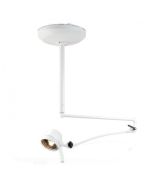
Offers























How to Choose the Right Minor Surgery Light for Your Clinic

In any clinical setting where minor procedures are performed—such as outpatient clinics, minor-ops rooms, dermatology suites or general-practice procedure rooms—the right lighting can make a major difference. Poor illumination may lead to shadows, eye-strain, inefficient workflow or even compromised outcomes. That’s why selecting the correct Minor Surgery Light is a key decision. At AHP Medicals we provide a range of minor surgery lighting solutions. Your choice should be guided by several critical factors to ensure you get the right fit for your room, staff, procedure types and budget.
Key features to evaluate when choosing your light
Here are the main criteria your clinic should assess:
1.Illuminance / Light intensity
- The strength of the light as measured in lux at a given distance is a core metric. The higher the lux, the better illumination of the procedure site (though more is not always better if it causes glare or heat). According to general surgical lighting standards, central illuminance (for deeper surgery) may go up to 160,000 lux, but for minor surgery rooms you may not need that kind of extreme level.
- Make sure your chosen unit provides sufficient lux at the working distance your staff will maintain (e.g., 0.8-1.2 m).
- Example: One model lists max illuminance at 1.0 m of 100,000 lux for the minor surgical lamp variant.
2.Colour rendering & colour temperature
- Colour rendering index (CRI) and especially red rendering (R9) matter when distinguishing subtle differences in tissue, blood, organs or wound edges. Some specialist minor lights list CRI (Ra) = 98, R9 = 93 or 97 in their specifications.
- Colour temperature (measured in Kelvin) influences the “feel” of the light; many choose daylight-white (~4,000-5,000 K) for clarity.
- The ability to render accurate skin tones (some lights quote “skin colour” index R13 = 98) is a plus.
3.Shadow control and light field uniformity
- In a minor surgery setting, the clinician’s head, hands, instruments can cast shadows. A good light will mitigate shadows, provide a wide and uniform light field so the procedure area remains clearly lit.
- Look at “depth of illumination” (how far the column of light penetrates) and “light field diameter” (size of the illuminated area). Example: one specification had depth ~900-1,100 mm and field diameter ~150-220 mm at certain working distances.
4.Mounting / Mobility / Ergonomics
- How will the light be installed? Wall-mounted, ceiling suspended, mobile floor stand? For clinics, mobile or wall-mounted may offer more flexibility.
- Handle design: Is it easy for the operator to reposition the light with one hand? One specification emphasises “single hand use; detachable sterilizable handle.
- Ergonomics: Ensure that the light head doesn’t intrude into the workflow, allows easy access for staff, does not interfere with other equipment, is comfortable to adjust.
5.Heat, energy consumption & LED longevity
- Traditional halogen lights generate more heat, require more energy and bulbs change more often. Switching to LED reduces heat load (important in small rooms), lowers energy consumption, and increases lifespan.
- Evaluate power consumption, cooling needs, bulb lifetime (LEDs typically > 40,000-60,000 hours). Example: one minor surgical lamp specs > 60,000 h LED lifetime.
6.Infection control & cleaning
- In healthcare environments cleaning and infection control matter. Lights with smooth surfaces, sealed light heads, easily cleanable handles and low dust/trap geometry are preferable. For example: “smooth and easy to clean design” is listed as a benefit.
7.Budget, service and lifecycle costs
- Initial purchase cost is one aspect; consider the total cost of ownership: bulb replacement cost (if halogen), service/maintenance, energy consumption, downtime during replacement, lifespan.
- A higher-quality LED unit may cost more upfront but save in energy and maintenance.
- Also consider after-sales support, parts availability, warranty, compatibility of accessories.
8.Room/Procedure specific requirements
- Consider the nature of your practice: What kinds of minor surgeries or procedures do you do? Are they superficial (skin procedures, dermatology) or slightly deeper (minor orthopaedics, outpatient surgery)?
- Room size, ceiling height, other equipment in room, ambient lighting conditions all impact what you should choose.
- If the room is multi-purpose (examination + procedure), you may want a more flexible light head or mobile unit.
Why choosing the “right” one matters
- Better illumination improves visibility of tissues, instruments, reduces risk of error. For example, correct colour and shadow-free light allows the surgeon to see subtle details.
- Staff comfort: fewer repositionings, less glare, less fatigue.
- Patient safety and hygiene: if the light is poorly mounted or allows dust/heat build-up, that can affect the room environment.
- Cost savings: less downtime, fewer bulb replacements, lower energy bills.
- Flexibility: a light that suits today’s procedures but also tomorrow’s needs allows your clinic to adapt.
AHP Medicals — Your partner in selecting Minor Surgery Lights
At AHP Medicals we stock a broad range of Minor Surgery Lights, suitable for outpatient clinics, minor procedure rooms and general practice facilities. Our team will help you:
- Understand the key features and match them to your room & workflows
- Select the correct mounting type (mobile, wall, ceiling)
- Review specifications (lux, CRI, light-field, ergonomics)
- Plan installation and servicing for your facility in the UK (or other regions we serve)
- Offer competitive pricing and fast fulfilment so your clinic can be properly equipped with minimal downtime
Final thoughts
Choosing the right minor surgery light is not just a purchase of a lamp — it’s an investment in procedure-quality, staff comfort, patient safety and long-term cost-effectiveness. By focusing on the key features (intensity, colour rendering, shadow control, ergonomics, infection control, lifecycle cost) and matching them to your clinic’s specific needs, you can make a smart decision. If you’d like a tailored quote or demonstration of our minor surgery lighting range, feel free to contact AHP Medicals — we’d be glad to assist you in getting the optimal lighting solution.
You can also buy other medical equipment from AHP Medicals,